
Physical activity supports physical and mental health throughout life. Yet a substantial share of adults worldwide do not reach recommended levels of activity.
The World Health Organization defines insufficient physical activity among adults as not reaching at least 150 minutes of moderate-intensity activity per week, 75 minutes of vigorous-intensity activity, or an equivalent combination.
Using modeled, age-standardized estimates from the WHO Global Health Observatory, we examined how insufficient physical activity varies across countries and whether the geographic patterns differ between females and males.
How we approached the data
The analysis uses a pinned snapshot from the WHO Global Health Observatory so that it can be reproduced without a live API connection. We checked the records for missing identifiers and duplicates, removed fields that were not needed, renamed and recoded the variables used in the analysis, and confirmed the expected country and year coverage before exporting the cleaned table.
For country comparisons, we use the 2022 estimates, the latest year available in the dataset. For the overall country comparison, each country contributes one both-sexes estimate: the estimated percentage of adults who did not meet recommended physical activity levels. When we summarize results across countries, each country counts equally rather than more populous countries having a greater influence.
This lets us describe variation between countries. It is different from estimating insufficient physical activity across the world's population, for which the analysis uses WHO's own modeled global estimates.
For the spatial analysis, WHO country estimates were joined to Natural Earth geographic data. We then derived and validated the female–male prevalence difference before mapping it with a diverging scale centered at zero.
Python · WHO Global Health Observatory · GeoPandas · Jupyter
A view across countries in 2022
Insufficient physical activity varies widely across countries
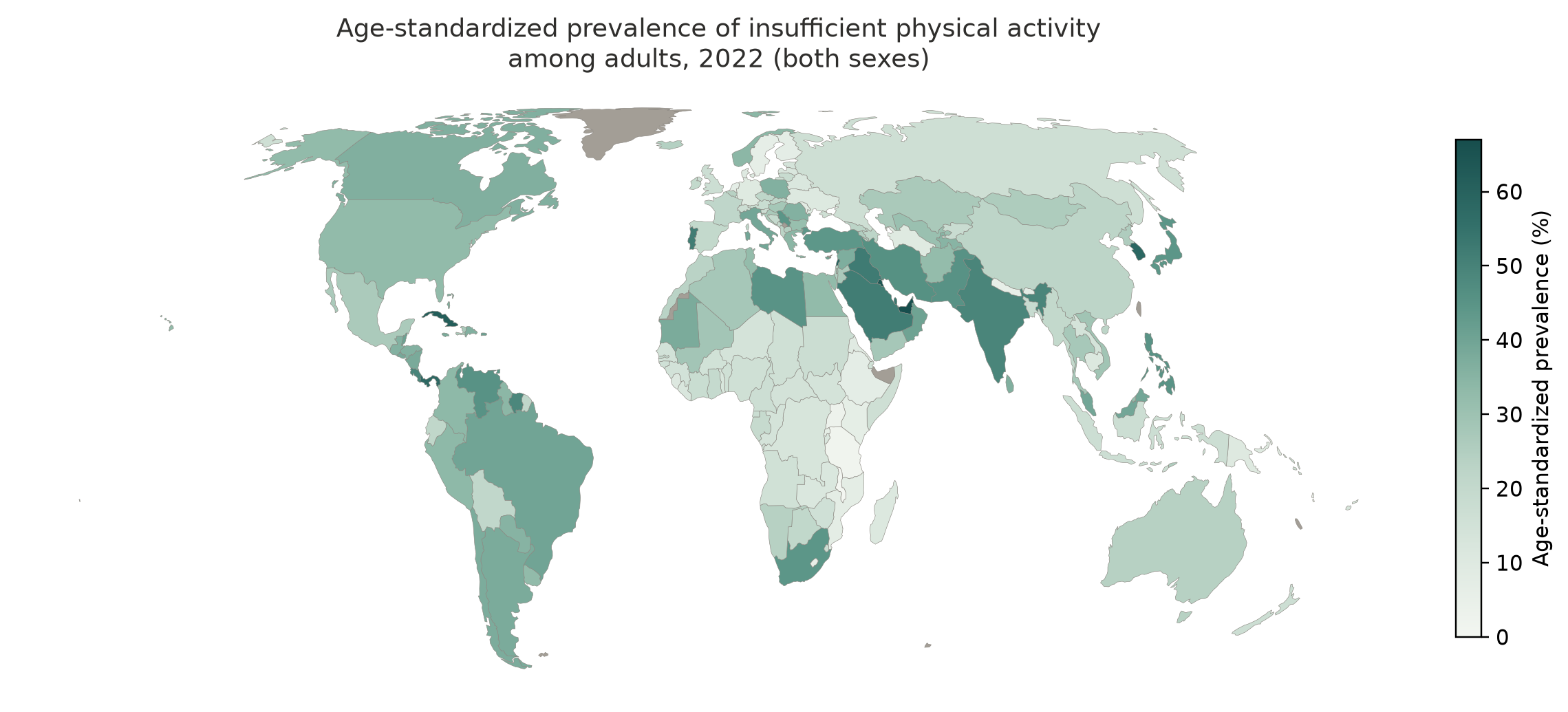
In 2022, the estimated percentage ranged from 2.7% to 66.1% across the 195 countries. The average of these country percentages was approximately 27.3%.
The geographic pattern differs between females and males
Looking separately at female and male estimates reveals another dimension of the data. Across countries, estimates averaged approximately 31.0% for females and 23.6% for males in 2022.
To explore how this difference varies geographically, we calculated an additional measure for every country:
Female prevalence − Male prevalence
Positive values indicate a higher estimated prevalence of insufficient physical activity among females. Negative values indicate a higher estimated prevalence among males.
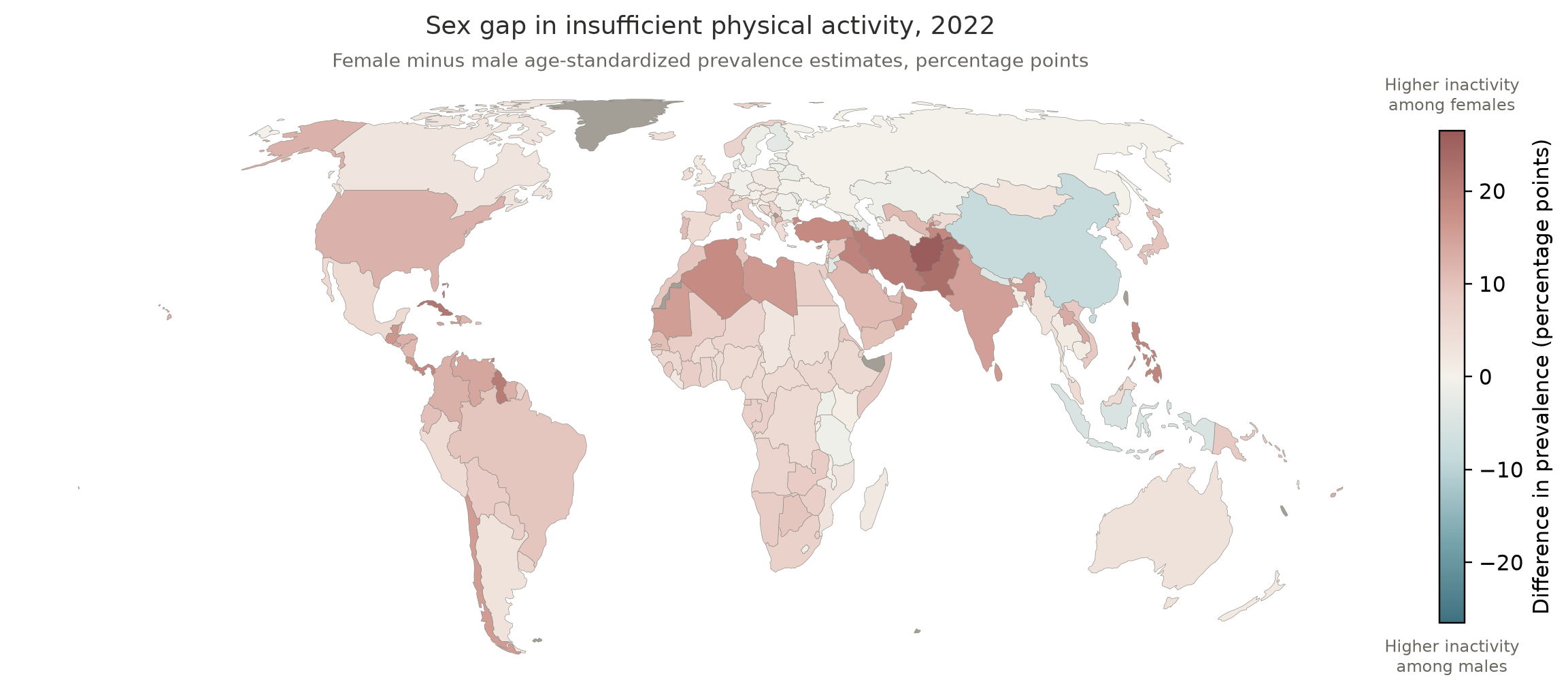
Higher estimates of insufficient physical activity among females are both more common and more pronounced
Female estimates of insufficient physical activity were higher than male estimates in 169 of 195 countries. Male estimates were higher in 26 countries.
Across all countries, the average female-minus-male difference in estimated prevalence was approximately +7.4 percentage points.
Afghanistan had the largest female-over-male difference at +26.01 percentage points. China had the largest male-over-female difference at −8.45 percentage points.
These are descriptive comparisons of WHO’s modeled estimates. The analysis does not test whether the differences are statistically significant or explain why they occur.
A note on map coverage
WHO estimates are available for all 195 countries included in the analysis. The Natural Earth 110m geometry used for the maps provides suitable polygons for 167 of them.
The remaining 28 are mainly small states and island countries that are not represented at this map resolution. They remain included in the statistical analysis. Not visible on the map does not mean missing WHO data.